The intersection of food science and artificial intelligence (AI) opens new frontiers in understanding, designing, and optimizing foods for better health, sustainability, and consumer experience.
The Food Informatics & Artificial Intelligence (FoodAI) group @NUS-FST focuses on developingfundamental data infrastructure and data-driven methods to decode the complexity of food systems—spanning molecular, sensory, safety, and environmental dimensions.
We integrate AI technologies, chem/bioinformatics, and life cycle assessment to support food innovation, ingredient discovery, and systems-level sustainability analysis. Key research themes include the AI-guided discovery of food bioactives and functional ingredients, food safety risk analysis, sustainable material design (e.g., functional proteins), sustainability assessment of food chemicals, multi-omics analysis for food quality and safety, and the application of generative AI for intelligent food formulation.
Current Research Projects
Fundamental large language models for food systems
Large language models for food science knowledge mining
AI-guided discovery of sweet proteins for plant-based burgers
AI-guided discovery for enzymes for food contaminant detoxification
Machine learning models for food flavor and off-note prediction
Multi-omics integration for food quality, authenticity, and safety analysis
AI-guided design of sustainable food chemicals and materials
Large-scale carbon footprint modeling of food chemicals in global commerce
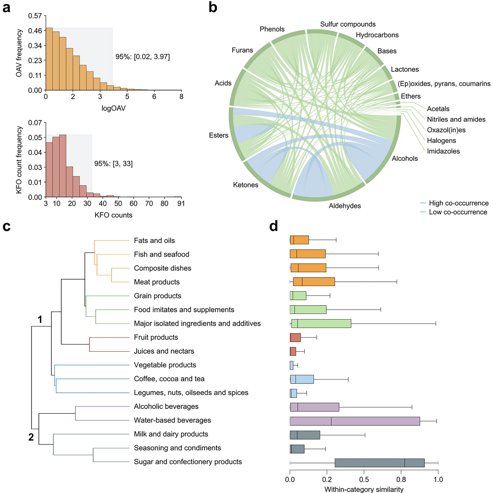
Molecular Atlas of Key Food Odorants Reveals Mixture-Level Organization and Enables Generative Aroma Design
Dr Dachuan Zhang’s FoodAI Group at the NUS Department of Food Science and Technology has published new work in Advanced Science on using AI to design new food aroma mixtures.
Food aromas are built from combinations of “key food odorants”, and there are thousands of possible combinations that give rise to different aromas. As a case study, the team developed a generative AI model that reconstructed meat-like aromas using exclusively plant-derived odorants. In a sensory test conducted, 30 consumers rated the AI-created aromas as more pleasant overall than a real meat aroma control.
It’s an early but exciting step toward using AI to speed up flavour development for sustainable, plant-based foods.
NUS Releases Key Initiatives and Practical Guide to Support Responsible Use of AI in Food Science
The Food Informatics and Artificial Intelligence (FoodAI) research group, at the Department of Food Science and Technology, National University of Singapore (NUS), together with international partners, has introduced five initiatives and a practical guide aimed at strengthening the responsible adoption of artificial intelligence (AI) in food science. The recommendations respond to growing interest in data-driven methods as well as persistent challenges around AI’s transparency and practical validation.